What happens when confidence becomes a product and uncertainty becomes a source of revenue? Directed by D. J. Caruso, Two for the Money (2005) examines the commercial world surrounding American sports betting. Rather than concentrating exclusively on gamblers or bookmakers, the movie follows individuals who sell predictions about sporting events to paying customers.
Matthew McConaughey portrays Brandon Lang, a former college football player whose athletic ambitions collapse following a serious injury. Al Pacino plays Walter Abrams, a charismatic businessman who recognizes Brandon's potential and transforms him into a marketable sports betting personality. Their partnership initially appears to offer extraordinary professional opportunities. However, its success depends on maintaining customer confidence in predictions that can never be guaranteed. Spoilers follow.
The Sports Picks Business
From football player to sports handicapper
Brandon's journey begins with the collapse of his original professional ambitions. After suffering a career-ending injury, he finds employment providing football predictions through a telephone service. His familiarity with football eventually attracts the attention of Walter Abrams, who recruits him to work for his New York sports consulting company.
The transition establishes an important distinction between understanding a sport and predicting its future results. Athletic experience can provide valuable knowledge, but it cannot eliminate the uncertainty of competition. Brandon's new career depends on convincing customers that his knowledge has commercial value.
What is a sports picks business?
A sports picks business sells opinions and predictions about sporting events rather than necessarily accepting wagers directly. Customers pay for access to information they believe may improve their gambling decisions.
| Participant | Role |
|---|---|
| Sports handicapper | Analyzes sporting events and produces predictions |
| Sports picks company | Commercializes predictions and customer access |
| Bookmaker | Accepts and settles wagers |
| Betting customer | Assumes the financial risk of gambling |
| Sales representative | Promotes the company's services |
Walter's organization operates primarily within the commercial environment surrounding gambling. Its customers purchase confidence in someone else's judgment. Purchasing a prediction does not remove the uncertainty of the underlying sporting event.
The business model behind Walter Abrams
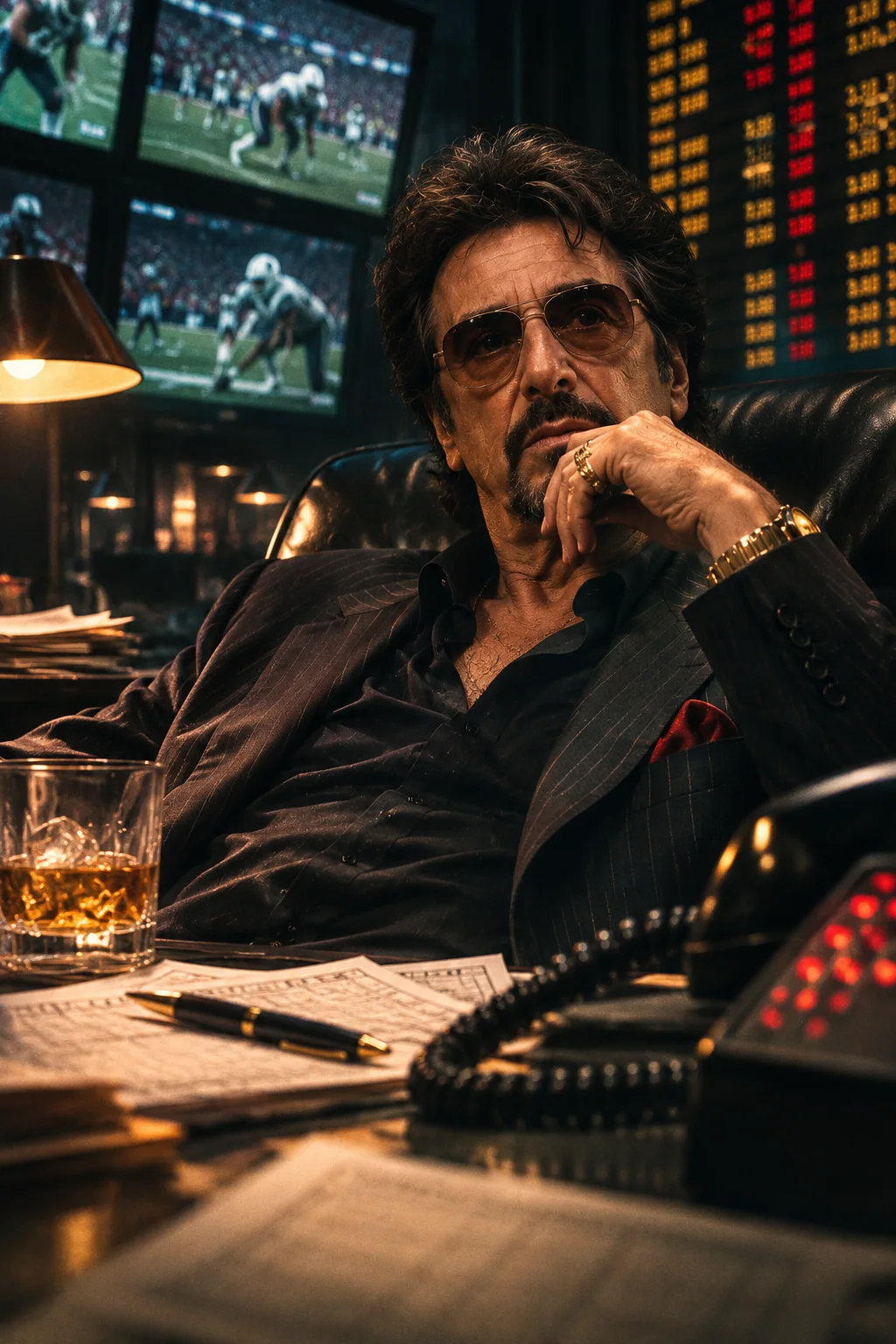
Walter understands that customers are attracted not only to sports knowledge but also to the emotional reassurance provided by an apparently successful expert. His organization relies heavily on telephone communication, television appearances, recognizable personalities, and persuasive presentation.
AI-generated editorial illustration; not an official film still.
The movie illustrates an important conflict of interest. A customer may lose money through gambling while the company supplying the prediction receives payment for its services. Although repeated customer losses can eventually damage the company's reputation, its immediate financial incentives do not necessarily align with the customer's financial well-being.
One of Walter's most important decisions involves transforming Brandon into a new public personality named John Anthony. The new identity is confident, sophisticated, assertive, and commercially attractive. Brandon's television appearances help turn his analytical abilities into a recognizable brand. His professional reputation no longer reflects only the quality of his work. It also depends on satisfying the expectations created by his public persona.
Salesmanship and Risk
Walter Abrams and the psychology of persuasion
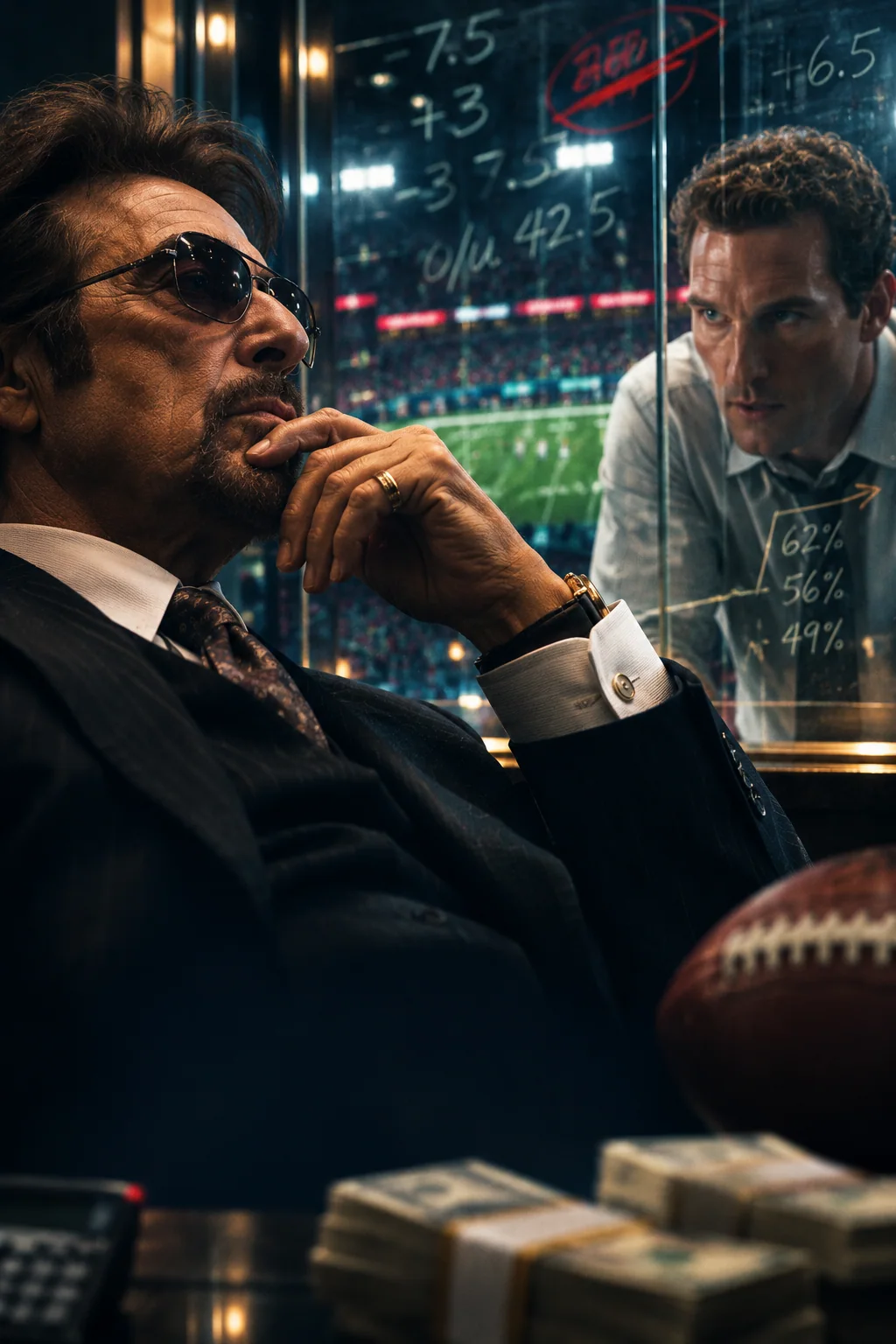
Walter recognizes that customers experiencing financial pressure may be particularly attracted to confident explanations and promises of improved circumstances. Al Pacino's energetic performance emphasizes Walter's ability to transform uncertainty into an emotionally compelling sales experience.
His approach illustrates the difference between evidence and persuasion. A confident presentation may make information appear more reliable without actually improving its accuracy. The movie gradually exposes the consequences of building a commercial relationship around this distinction.
Authority bias describes the tendency to assign greater credibility to information presented by someone perceived as an expert. Brandon's athletic background contributes to his professional credibility. His television presence and confident public identity reinforce that perception. However, expertise does not guarantee the accuracy of future sporting predictions.
Why winning streaks can be misleading
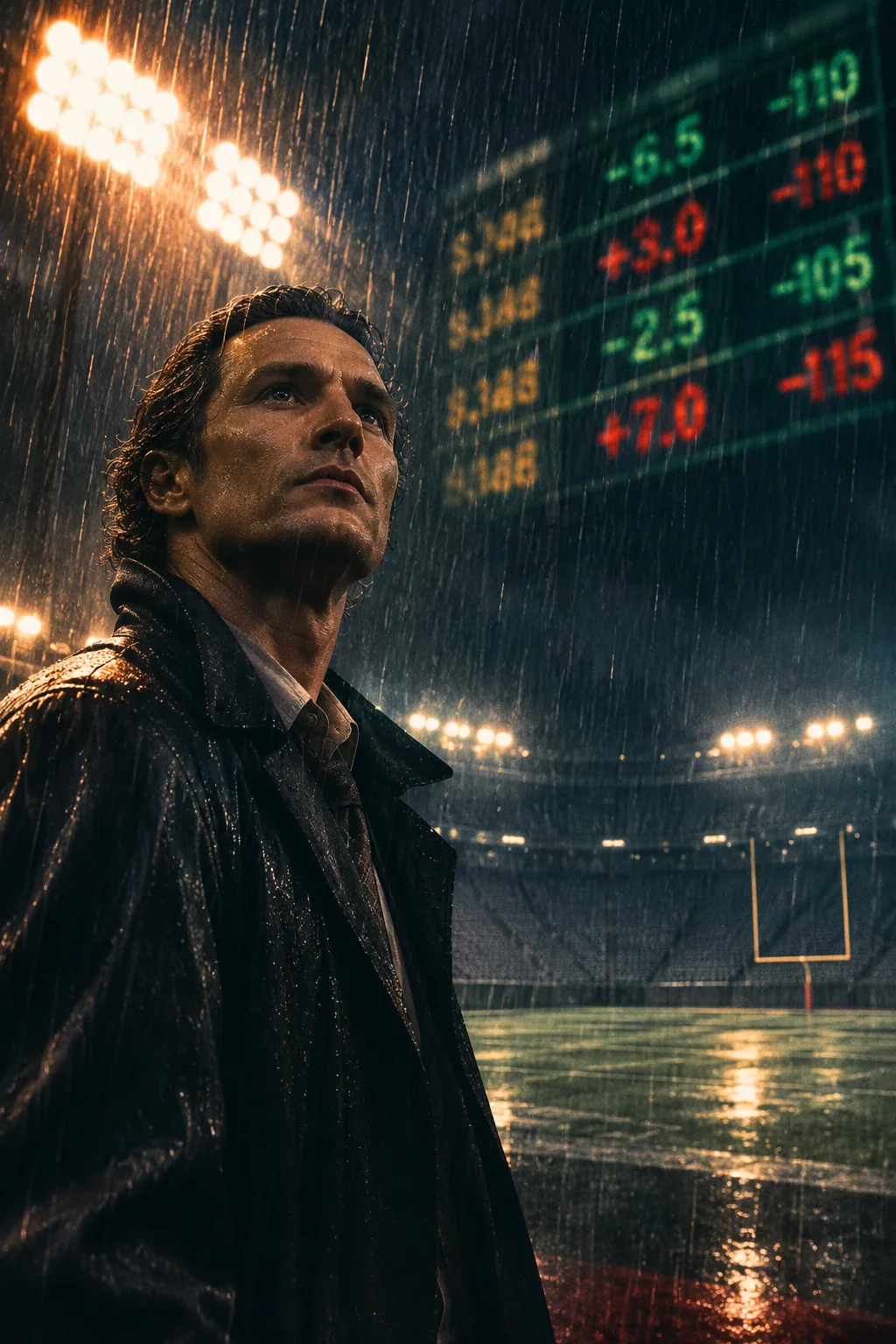
Brandon's early success attracts customers and strengthens his reputation. However, short periods of favorable results do not necessarily establish that someone possesses a durable predictive advantage. Sporting outcomes involve numerous uncertain variables. Injuries, individual performances, unexpected decisions, and random events can all affect results.
The movie dramatizes the danger of interpreting a successful sequence as proof that future success is guaranteed. When Brandon's predictions deteriorate, the confidence surrounding his public identity collapses. His experience illustrates how quickly commercial reputations built around uncertain outcomes can become unstable.
AI-generated editorial illustration; not an official film still.
As Brandon becomes increasingly successful, the expectations placed upon him grow. Customers want additional favorable results, Walter expects continued commercial expansion, and Brandon feels pressure to preserve his newly acquired identity. His work becomes connected to his self-esteem. Acknowledging uncertainty can feel like admitting personal failure.
Gambling psychology in Two for the Money
Customers who experience unfavorable outcomes may become increasingly determined to recover their money. This behavior is known as loss chasing. Rather than accepting previous losses, individuals expose themselves to additional financial risk in the hope of reversing their circumstances. A commercial environment that encourages continued participation can intensify this vulnerability.
Overconfidence bias occurs when individuals overestimate the accuracy of their judgments or the extent of their knowledge. As favorable results accumulate, Brandon becomes increasingly dependent on the belief that he possesses an exceptional ability to predict sporting outcomes. His subsequent difficulties demonstrate the fragility of an identity built around results that cannot be fully controlled.
Walter's behavior introduces a different form of psychological instability. Although he operates a sports consulting company, his emotional relationship with gambling extends beyond ordinary commercial activity. The film explores his previous gambling problems and his continuing attraction to uncertainty, competition, and financial excitement.
Rene Russo's Toni provides an important emotional perspective. Her relationship with Walter exposes the personal consequences of his behavior, while her interactions with Brandon reveal the growing instability of the partnership. Toni recognizes that financial success cannot compensate indefinitely for damaged relationships.
Two for the Money ending explained
The final act exposes the limitations of Brandon's reputation as an extraordinary sports predictor. After experiencing a damaging sequence of unsuccessful predictions, he makes a final selection using a coin toss. The decision undermines the commercial mythology Walter has constructed around him.
Although the final predictions prove successful, their favorable results do not establish the reliability of the process behind them. The ending illustrates outcome bias: the tendency to evaluate a decision according to its result rather than the quality of the reasoning that produced it. Brandon ultimately leaves the sports picks business and returns to football through coaching. His departure represents an opportunity to reconnect with his original interests without making his identity dependent on gambling predictions.
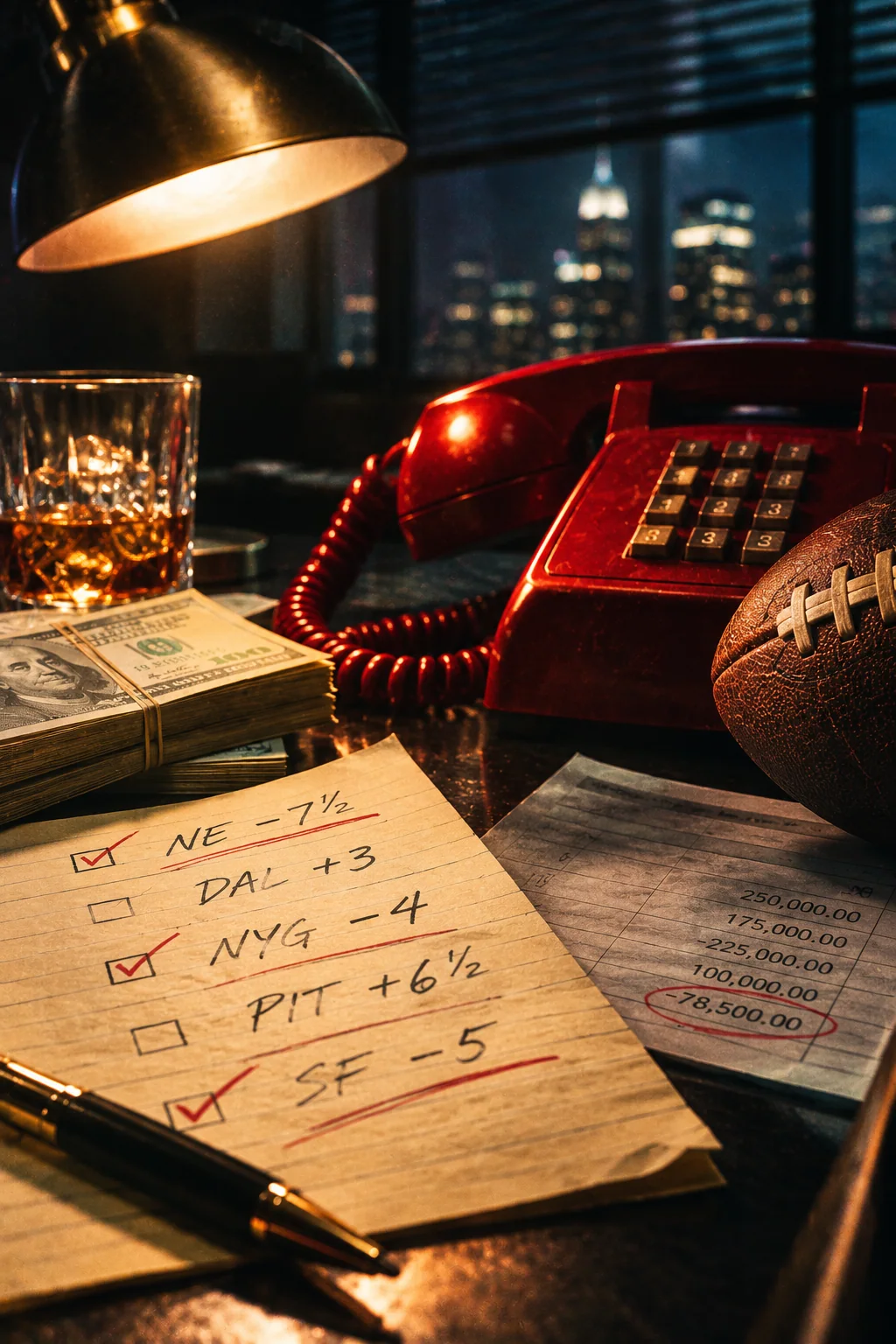
AI-generated editorial illustration; not an official film still.
Is Two for the Money based on a true story?
The film was inspired by the experiences of a real sports handicapper known professionally as Brandon Lang, whose real name is Brandon Lane. Reporting published by the Las Vegas Sun in 2006 examined the connections between Lane's experiences and the movie's fictionalized narrative. However, the film's private conversations, relationships, and dramatic confrontations should not automatically be interpreted as documented historical events.
For a contrasting perspective on the customer's experience, read Uncut Gems. Bookies examines unauthorized bookmakers, while Runner Runner considers corporate responsibility in online gambling.
Frequently asked questions
What is the movie about? A former football player becomes a successful sports handicapper before experiencing the consequences of financial pressure and unreliable predictions.
Is Walter Abrams a bookmaker? The movie primarily presents him as the owner of a sports consulting business rather than a conventional bookmaker.
Who is John Anthony? Brandon's commercial identity.
Can handicappers guarantee winning bets? No. Sporting outcomes remain uncertain, and paying for predictions does not guarantee financial returns.
Final thoughts
Two for the Money offers a distinctive perspective on gambling cinema by examining the business of selling predictions. Its central conflict demonstrates how financial incentives, persuasive communication, personal ambition, and customer vulnerability can become interconnected. Confidence can be sold, but certainty cannot.